
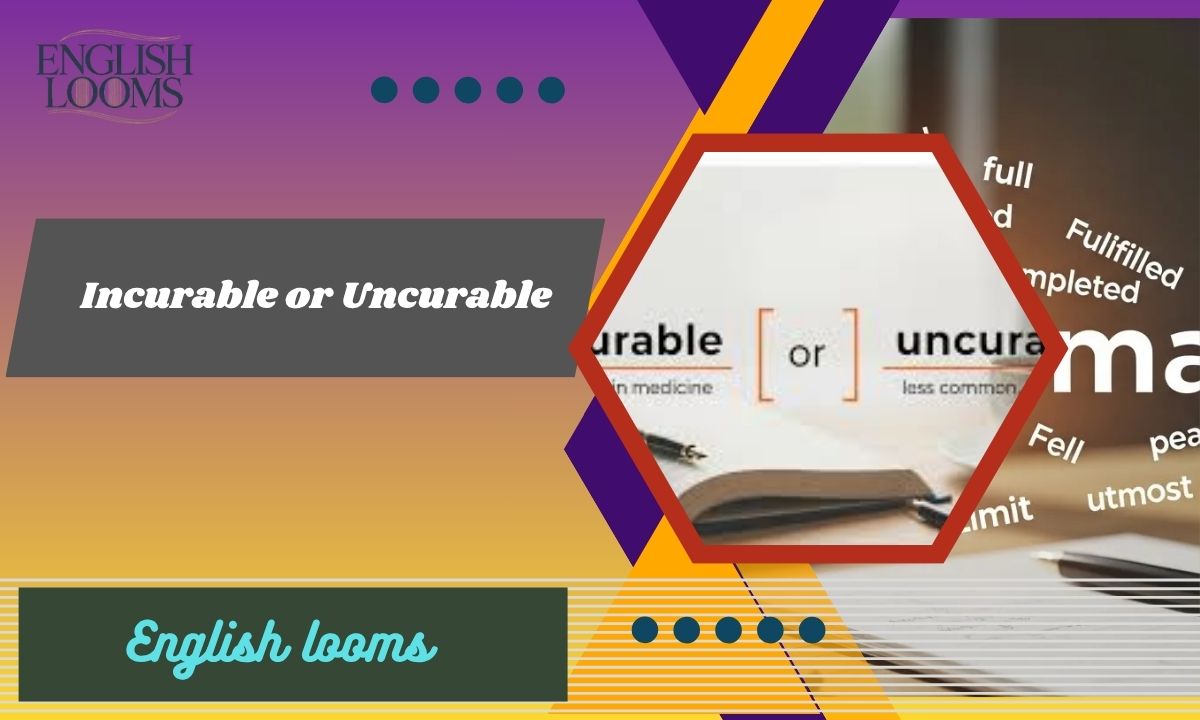
Many people get confused between incurable and incurable because both words seem correct. This spelling mistake is common in medical writing, blogs, and everyday English. However, only one word is accepted in standard English.
In this guide, you will learn the correct spelling, meaning, and usage of incurable and why incurable is considered incorrect. You will also see simple examples, grammar tips, and the difference between these two spellings in British and American English.
Incurable or Uncurable – Quick Answer
Incurable is the correct and standard spelling in modern English.
Incurable is generally considered incorrect or nonstandard in professional, academic, and published writing.
The word incurable means:
- Impossible to cure
- Not able to be healed
- Difficult or impossible to change
It is commonly used in:
- Medical language
- Academic writing
- News articles
- Everyday expressions
Correct Examples
- The disease is incurable, but treatment can reduce symptoms.
- She suffers from an incurable condition.
- He is an incurable optimist.
- Doctors continue researching incurable illnesses.
- The damage appears incurable.
Incorrect Examples
- ❌ The illness is uncurable.
- ❌ She has an uncurable disease.
- ❌ The condition remains uncurable.
Even though some historical references mention incurable, modern English strongly favors incurable. Most spellcheck tools flag incurable as an error.
The Origin of Incurable and Uncurable
The history of these words explains why English accepts one spelling and rejects the other.
Latin Roots
The word incurable comes from the Latin word incurabilis.
It breaks down like this:
| Part | Meaning |
| in- | not |
| curare | to heal or cure |
| incurabilis | unable to be cured |
English borrowed the word directly from Latin and preserved its original structure. That is why the prefix became in- instead of un-.
Major dictionaries confirm that incurable entered Middle English centuries ago and has remained the standard form ever since.
Why Incurable Never Took Hold
English often uses the prefix un- in words like:
- unhappy
- unfair
- unclear
- uncomfortable
Because of this pattern, many writers assume incurable should also exist. However, English vocabulary does not always follow simple logic.
Over time:
- Incurable became standardized in dictionaries
- Editors and publishers preferred incurable
- Medical and academic communities adopted only incurable
- Incurable became rare and mostly disappeared from formal usage
Some historical dictionaries and references still mention incurable as an archaic or rare variant, but it is not recommended in modern writing.
British English vs American English Spelling

Some spelling differences depend on region, such as:
- colour vs color
- organise vs organize
- finalise vs finalize
However, this is not one of those cases.
Key Point
Both British English and American English are incurable.
There is no accepted regional spelling called incurable.
Comparison Table
| Feature | British English | American English |
| Correct spelling | Incurable | Incurable |
| Accepted by dictionaries | Yes | Yes |
| Used in medicine | Yes | Yes |
| Academic usage | Yes | Yes |
| “Uncurable” accepted? | No | No |
Whether you write for readers in the UK, USA, Canada, Australia, or India, the correct spelling remains incurable.
Which Spelling Should You Use?
Choosing the correct spelling matters because it affects clarity, professionalism, and trust.
For US Audiences
Use incurable in all professional and casual writing.
American dictionaries, universities, and medical publications recognize only incurable as standard English. Using incurable may appear careless or unedited.
For UK & Commonwealth Audiences
British English also strongly prefers incurable.
Major UK dictionaries such as Cambridge Dictionary and Britannica use only the standard spelling.
For Global or SEO Writing
If you create:
- blog posts
- SEO articles
- educational content
- grammar guides
- medical pages
always use incurable as the primary keyword.
Why?
- Google recognizes incurable as the standard term
- Search engines trust dictionary-approved spellings
- Readers view the content as more credible
- Spellcheck systems support it
You may mention incurable only when explaining why it is incorrect.
Common Mistakes with Incurable vs Incurable
Writers often make predictable spelling mistakes with these words.
1. Assuming “un-” Is Always Correct
Many English adjectives use “un-” for negatives.
Examples:
- unfair
- unclean
- unsafe
This causes writers to incorrectly form:
- ❌ uncurable
Correct form:
- ✅ incurable
2. Overcorrecting Based on Logic
English spelling is influenced by:
- Latin roots
- historical borrowing
- pronunciation patterns
- dictionary standardization
Even if incurable feels logical, English history is preserved incurable instead.
3. Using “Uncurable” in Informal Writing
Some people believe grammar rules matter only in formal writing. However, even in:
- blogs
- emails
- captions
- comments
- social media posts
incurable still looks incorrect to most readers.
4. Ignoring Spellcheck Warnings
Modern writing tools usually flag:
- ❌ uncurable
and suggest:
- ✅ incurable
Ignoring these warnings can hurt readability and professionalism.
Incurable vs Incurable – Comparison Table

| Feature | Incurable | Uncurable |
| Standard English | ✅ Yes | ❌ No |
| Dictionary accepted | ✅ Yes | ❌ Rare/Nonstandard |
| Medical usage | ✅ Yes | ❌ No |
| Academic writing | ✅ Yes | ❌ No |
| SEO friendly | ✅ Yes | ❌ Weak |
| Professional writing | ✅ Yes | ❌ Avoid |
| Used globally | ✅ Yes | ❌ Rare |
| Recommended spelling | ✅ Yes | ❌ No |
Incurable in Everyday Examples
Understanding a word becomes easier when you see it in real contexts.
Emails
“The doctor explained that the illness is incurable but manageable.”
“We are funding research into incurable diseases.”
News Articles
“Scientists continue searching for treatments for incurable disorders.”
“The patient was diagnosed with an incurable condition.”
Social Media
“He’s an incurable football fan.”
“She is an incurable romantic.”
Academic Writing
“The disease was considered incurable before modern medicine improved treatments.”
“Researchers studied incurable neurological disorders.”
Professional Reports
“The patient suffers from an incurable respiratory disease.”
“The damage appears incurable under current conditions.”
Incurable and Incurable – Google Trends & Usage Data
Search behavior shows a strong preference for incurable worldwide.
Popularity by Country
The word incurable dominates searches in:
- United States
- United Kingdom
- Canada
- Australia
- India
- Pakistan
Grammar websites and dictionaries consistently recommend incurable as the correct spelling.
Why “Incurable” Appears in Searches
People still search for incurable because:
- they rely on spelling logic
- English learners test both forms
- users confuse prefixes
- autocorrect sometimes fails
- they want confirmation
This is why many grammar websites create articles comparing the two spellings.
Content Insight
SEO analysis of top-ranking grammar pages shows several patterns:
- clear quick-answer sections
- simple examples
- comparison tables
- FAQ sections
- short paragraphs
- direct explanations
Top-ranking pages also naturally use related NLP keywords such as:
- correct spelling
- standard English
- medical terminology
- dictionary definition
- grammar mistake
- English usage
- professional writing
- language rules
- spelling difference
- British vs American English
Using these naturally improves search visibility without keyword stuffing.
Frequently Asked Questions
Is incurable ever correct?
In modern standard English, incurable is usually considered incorrect or nonstandard.
Why does incurable sound right?
Because English commonly uses the prefix “un-,” many people assume it should work with “curable.”
Do dictionaries accept incurable?
Some dictionaries list it as rare or archaic, but modern writing strongly prefers incurable.
Is incurable formal or medical only?
No. It is also used in everyday speech for personality traits and habits.
Can incurable be used creatively?
It may appear in fiction or creative writing, but many readers still see it as a spelling error.
Is British English incurable?
No. British English uses incurable as the correct spelling.
Is there a verb form related to incurable?
Yes. The related verb is cure.
Conclusion
The difference between incurable and incurable is mainly about standard English usage and historical language development.
Although incurable may seem logical because of the “un-” prefix, English adopted the Latin-based word incurable centuries ago and kept that structure. Today, dictionaries, editors, academic institutions, and medical professionals all recognize incurable as the correct spelling.
David is the founder of englishlooms.com, a site dedicated to Grammer and Prayers clever wordplay. He loves turning language into laughter and making words wonderfully witty.