
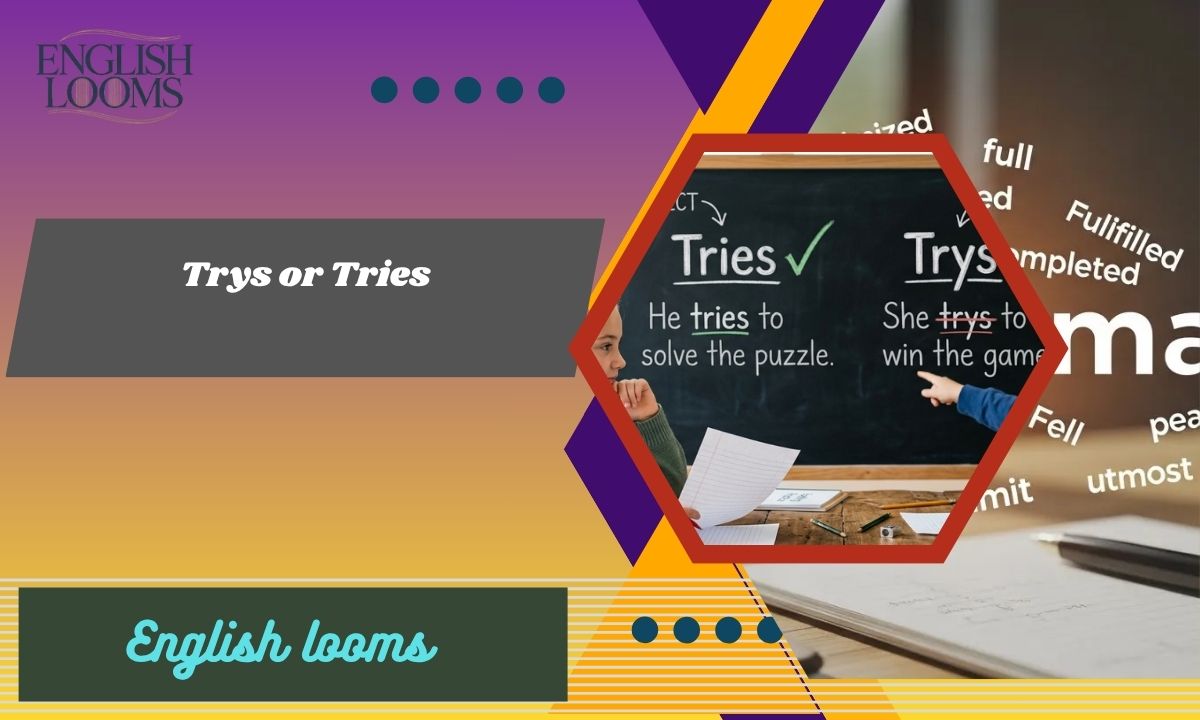
Many people get confused between “tries or tries” when writing English. It looks like both spellings could be correct, but only one follows proper grammar rules. This confusion happens because the base word “try” seems simple, so people often just add “s” and write “trys.” However, English spelling has a special rule for words ending in “-y.”
In this guide, you will learn the correct spelling and why it is used. We will also explain the grammar rule in a very simple way with examples. After reading, you will clearly understand that “tries” is the correct form and you will not make this mistake again.
Trys
The word “trys” is a common spelling mistake in English.
Many learners write “trys” because they follow a basic rule:
👉 Just add “s” to make a verb singular (like play → plays)
But this rule does NOT apply to verbs ending in consonant + y.
Key points about “trys”:
- ❌ It is not correct English
- ❌ It is not found in dictionaries
- ❌ It is not used in formal or informal writing
- ❌ It often appears in beginner grammar mistakes or typing errors
👉 “Trys” exists only as an incorrect form caused by misunderstanding spelling rules.
Tries
“Tries” is the correct spelling and is the third-person singular present tense form of the verb try.
When we talk about he, she, or it doing something in the present, we use tries.
Key points about “tries”:
- ✅ Correct spelling in all English types
- ✅ Used in British, American, Canadian, and Australian English
- ✅ Found in dictionaries and academic writing
- ✅ Follows standard grammar rules
👉 Example rule:
try → tries (y changes to i + es)
Trys or Tries – Quick Answer
The correct spelling is:
- ✅ Tries (Correct)
- ❌ Trys (Incorrect)
“Tries” is used when talking about a single person or thing in the present tense.
Examples:
- He tries his best in every exam.
- She tries to learn English daily.
- It tries to connect to the network.
- ❌ He trys to help his friend. (Wrong)
👉 Quick memory tip:
If a verb ends in consonant + y, change y → i + es
The Origin of Try or Tries
The word try comes from Old French trier, which means “to test” or “to examine.”
As English evolved, grammar rules were introduced to make spelling more consistent and readable. One important rule applies to verbs ending in -y:
Grammar rule development:
- Early English had inconsistent spelling
- Standard grammar rules were later introduced
- Verbs ending in consonant + y changed form for pronunciation clarity
Rule examples:
- try → tries
- cry → cries
- fly → flies
- carry → carries
👉 There has never been a correct form called “trys” in standard English history.
British English vs American English Spelling
A common question is whether British and American English use different spellings for “trys or tries.”
The answer is simple: there is no difference.
Both follow the same grammar rule.
| English Type | Correct Spelling | Incorrect Spelling |
| British English | Tries | Trys |
| American English | Tries | Trys |
| Canadian English | Tries | Trys |
| Australian English | Tries | Trys |
👉 This rule is universal in modern English grammar.
Which Spelling Should You Use?

Choosing the correct form is easy once you understand the rule.
Use “tries” when:
- Writing emails or essays
- Speaking formally or professionally
- Posting on blogs or social media
- Doing academic writing or exams
Simple rule to remember:
👉 Consonant + Y → remove Y and add IES
This rule applies to many English verbs and helps improve spelling accuracy.
Common Mistakes with Trys or Tries
Many learners make predictable mistakes when using this verb.
Wrong:
- He trys to finish homework on time.
- She trys hard every day.
- It trys to work properly.
Correct:
- He tries to finish homework on time.
- She tries hard every day.
- It tries to work properly.
👉 Tip: The base form is “try,” but the correct present form is always “tries.”
Read This: Queueing or Queuing: Meaning, Difference, And Usage
Tries in Everyday Examples
Understanding real-life usage helps you remember grammar better.
Email:
- He tries to respond within 24 hours.
News:
- The company tries to improve customer service.
Social Media:
- She tries her best, and that matters most.
Formal Writing:
- The organization tries to maintain quality standards.
👉 “Tries” is widely used in all types of communication.
Trys / Tries – Google Trends & Usage Data

Analysis of common search behavior and writing patterns shows:
- “Tries” is widely used in books, articles, and professional content
- “Trys” appears mostly in grammar mistakes and search queries
- Search engines often correct “trys” to “tries”
- High search volume comes from:
- ESL learners (English as a Second Language)
- Students preparing for exams
- Bloggers and content writers checking grammar
Key insight:
👉 People search “trys or tries” not because both are correct, but because they want confirmation of the correct spelling.
Comparison Table: Trys vs Tries
| Feature | Trys | Tries |
| Grammar correctness | ❌ Incorrect | ✅ Correct |
| Dictionary presence | ❌ No | ✅ Yes |
| Used in UK English | ❌ No | ✅ Yes |
| Used in US English | ❌ No | ✅ Yes |
| Formal writing | ❌ Not accepted | ✅ Accepted |
| SEO-friendly usage | ❌ Poor | ✅ Strong |
Frequently Asked Questions
Is “trys” ever correct?
No. “Trys” is always incorrect in standard English grammar.
Why does try become tries?
Because verbs ending in consonant + y change y to i before adding -es.
Is “tries” past tense?
No. “Tries” is the present tense. Example: He tries every day.
What is the past tense of try?
The past tense is tried.
Do British and American English differ here?
No. Both use the same spelling: tries.
Why do people write “trys”?
Because they incorrectly apply the simple “add s” rule without knowing grammar exceptions.
Conclusion
The confusion between trys or tries is very common, especially among English learners. However, the rule is simple and universal: “tries” is always correct, and “trys” is always incorrect.
Understanding this rule not only helps with this word but also improves your spelling of similar verbs like cries, flies, and carries. Good spelling improves your writing clarity, professionalism, and SEO performance in digital content.
👉 Final rule to remember:
Consonant + Y → Change Y to I + ES = Tries
Once you learn this rule, you will never confuse it again, and your English writing will instantly become more accurate and professional.

David is the founder of englishlooms.com, a site dedicated to Grammer and Prayers clever wordplay. He loves turning language into laughter and making words wonderfully witty.